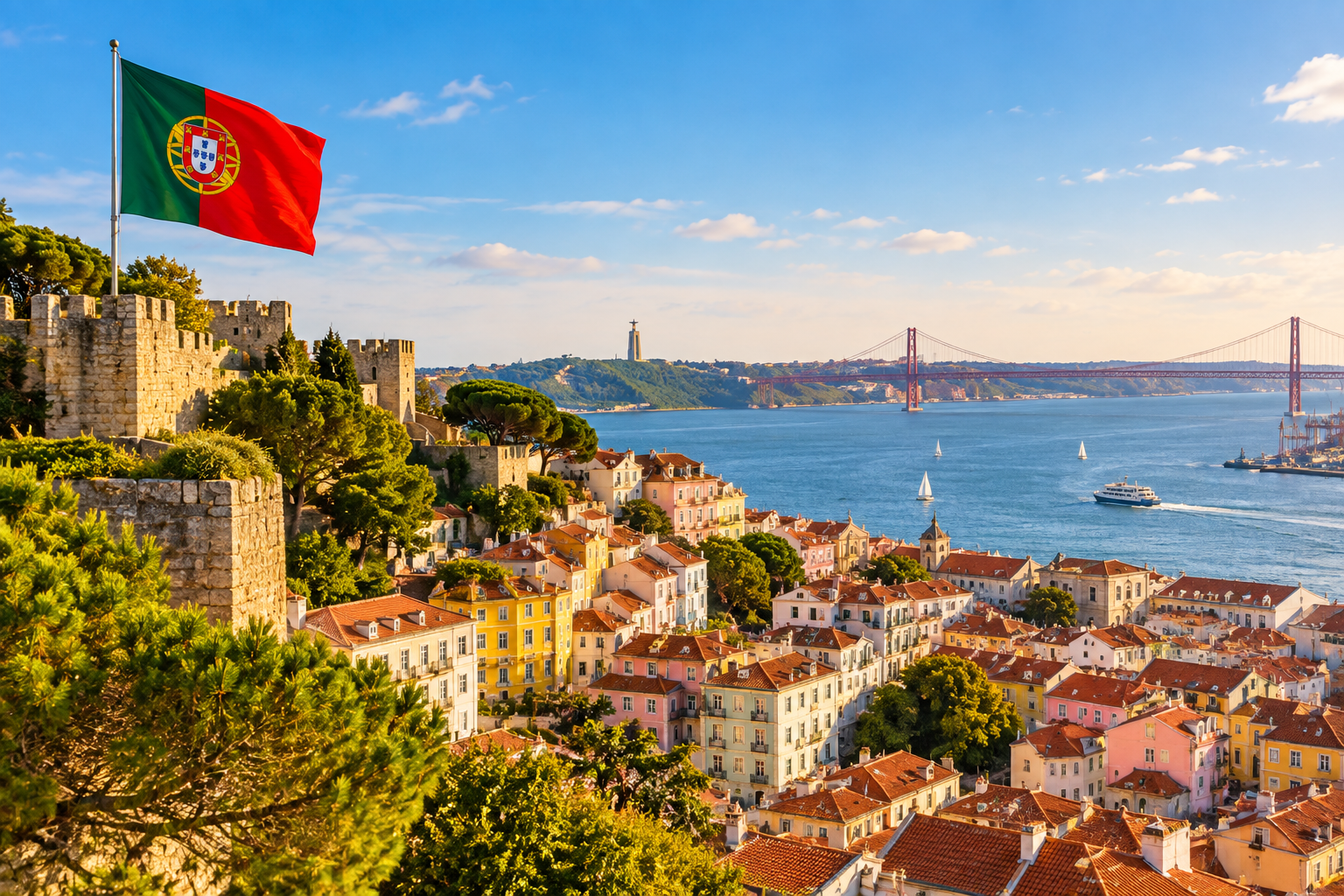
The best places to visit in Portugal depend on the kind of trip you want. Lisbon is the easiest starting point for a first visit, Porto combines historic streets with food and wine, the Algarve is the main choice for a beach holiday, and Sintra is ideal for palaces and wooded scenery. For a more nature-focused trip, look to Madeira, the Azores, the Douro Valley or Peneda-Gerês.
Rather than trying to see the whole country, most first-time visitors will get more from choosing two or three destinations that offer different experiences.
Where to Go in Portugal: Quick Guide
| If you want… | Consider… |
|---|---|
| First trip or city break | Lisbon |
| Historic city, food and wine | Porto |
| Palaces and romantic scenery | Sintra |
| Beaches and coastal cliffs | Algarve |
| Wine landscapes | Douro Valley |
| Hiking and dramatic island scenery | Madeira |
| Volcanic landscapes and outdoor adventure | Azores |
| History and a slower pace | Évora and Alentejo |
| Historic university city | Coimbra |
| Surf culture and Atlantic scenery | Nazaré |
| Small medieval town | Óbidos |
| Mountains and hiking | Peneda-Gerês |
The current Lonely Planet Portugal guide follows a similar destination-based approach, mixing major cities, beaches, wine country and smaller historic places rather than treating Portugal as a list of cities alone. Lonely Planet’s best places to visit in Portugal
Best Places to Visit in Portugal
Lisbon — A Strong Choice for a First Trip
Lisbon is the most straightforward starting point if you want a little of everything: historic neighborhoods, viewpoints, nightlife, food, museums and easy day trips.
Alfama is the place for steep lanes and older city fabric, while Baixa and Chiado put you closer to central squares, shops and restaurants. Belém adds some of the city’s best-known monuments, and São Jorge Castle gives a broad view across the rooftops and the Tagus.
Lisbon works particularly well on a first trip because it does not lock you into one type of vacation. You can spend one day exploring historic neighborhoods, another around museums and waterfront areas, and then leave the city for Sintra or the coast.
Allow roughly 2–4 days, depending on how many excursions you want to make. If your entire Portugal trip lasts only four or five days, Lisbon and one nearby destination can already fill it comfortably.
Porto — For Food, Wine and Riverside Scenery
Porto has its own rhythm and should not be treated simply as a smaller version of Lisbon.
The historic center slopes toward the Douro River and Ribeira, while the opposite bank at Vila Nova de Gaia is closely associated with port wine cellars. Blue-and-white tiled buildings, narrow streets and river views give Porto a distinctive visual character.
It suits couples, food and wine travelers and anyone who wants a compact city break with less ground to cover than Lisbon.
Porto is also the natural gateway to the Douro Valley, making the two an easy combination. Around 2–3 days works well for the city itself, with extra time if you are continuing into wine country.
Sintra — For Palaces and Wooded Hills
Sintra is one of the easiest places to add to a Lisbon itinerary while making the trip feel completely different.
The area is known for Pena Palace, Quinta da Regaleira, historic estates and green hills that contrast sharply with central Lisbon. The appeal is not just individual monuments; it is the combination of elaborate architecture and a cool, forested setting.
Many travelers visit Sintra as a day trip from Lisbon, which is practical if time is limited. Staying overnight can make sense if you want a slower visit rather than trying to fit several major sights into a single busy day.
For most itineraries, one full day is enough to understand why Sintra is consistently included among Portugal’s main destinations.
Algarve — For Beaches and a Coastal Holiday
The Algarve is a region, not a single resort town, and where you stay can change the character of the trip considerably.
Lagos works well for dramatic cliffs, beaches and outdoor activities. Tavira offers a quieter atmosphere and a more historic feel. Faro is an important transport gateway with its own old town, while parts of the central Algarve provide a more developed resort experience.
The main draw is the coast: sandy beaches, rock formations, cliffs, coastal walks and water activities.
If beaches are the priority, give the Algarve at least 3–5 days rather than squeezing it into an overnight stop. It pairs naturally with Lisbon on a week-long trip, especially for travelers who want to split their time between a city and the coast.
Douro Valley — For Wine and River Landscapes
The Douro Valley is one of the most scenic places in Portugal, with vineyards arranged across steep slopes above the river.
Travel here is as much about the landscape as wine. Roads, trains and river journeys provide different views of the valley, while wine estates are scattered throughout the region.
It is an easy extension from Porto. A day trip gives a first impression, but one or two nights allow more time to enjoy the scenery without spending much of the day traveling back to the city.
Travel + Leisure includes both the Douro Valley and Peneda-Gerês among Portugal’s notable destinations, highlighting the Douro’s terraced vineyard landscape and the country’s northern natural scenery. Travel + Leisure’s Portugal destination guide
Madeira — For Hiking and Dramatic Island Scenery
Madeira is a better choice for mountains, walking and scenic drives than for a conventional beach-resort vacation.
The island combines steep mountains, cliffs, dense vegetation and a famous network of levadas, or irrigation channels, many of which now form walking routes through the landscape. Funchal provides a city base, while much of Madeira’s appeal lies outside the capital.
Choose Madeira if you enjoy hiking, viewpoints, road trips and active days outdoors. It works particularly well for couples and travelers who want dramatic landscapes without moving between several mainland destinations.
For a first visit, roughly 4–7 days gives enough time to see different parts of the island without rushing.
The official Portuguese tourism portal describes both Madeira and the Azores as distinct Atlantic island destinations, with Madeira especially associated with levada walking and lush mountainous landscapes. Visit Portugal’s guide to Madeira and the Azores
Azores — For Volcanic Landscapes and Outdoor Adventure
The Azores offer a very different island experience from Madeira.
This nine-island archipelago is shaped by volcanic geology: crater lakes, hot springs, geothermal areas, rugged coastlines and green interior landscapes. Whale and dolphin watching, hiking and scenic drives are major reasons to visit.
For a first trip, São Miguel is the most obvious place to start. It combines volcanic lakes such as Sete Cidades and Lagoa do Fogo with thermal areas and enough variety to fill several days.
Do not try to cover all nine islands on a short vacation. Four to seven days on São Miguel alone can make a satisfying first Azores trip; island hopping makes more sense when you have additional time.
Évora and the Alentejo — For History and a Slower Pace
Évora and the surrounding Alentejo are good alternatives when you want historic Portugal without the pace of Lisbon, Porto or the main beach resorts.
Évora has a compact historic center and visible Roman heritage, while the wider region is characterized by countryside, smaller whitewashed towns, food and wine.
This part of Portugal works particularly well on a road trip. Distances between points of interest encourage slower travel, and the landscape is part of the experience rather than simply the space between attractions.
Allow one or two days for Évora itself, or several more if you plan to explore the Alentejo by car.
Coimbra — For History and University Atmosphere
Coimbra fits naturally into a route between Lisbon and Porto.
The city’s identity is closely tied to its historic university, old streets and student population. It offers enough history to justify a stop without requiring the amount of time that Lisbon or Porto does.
For many travelers, one full day or one overnight stay is about right. Coimbra is especially useful when you have a longer mainland itinerary and want to break up the north-south journey with a city that feels different from the two major urban centers.
Nazaré — For Atlantic Scenery and Surf Culture
Nazaré combines a traditional coastal-town identity with an international reputation for surfing.
The upper viewpoints and broad Atlantic setting make it worth visiting even when giant waves are not present. Those famous waves are seasonal and dependent on ocean conditions, so they should not be treated as something visitors are guaranteed to see.
Nazaré works well as a road-trip stop or a short coastal stay. One day is enough for the main town and viewpoints; stay longer if you want beach time or a slower Atlantic-coast break.
Óbidos — For a Compact Medieval Town
Óbidos is one of the easiest smaller towns to add to a Portugal trip.
The historic core is enclosed by walls and compact enough to explore without a long stay. Narrow streets, whitewashed buildings and the preserved medieval layout create a very different experience from the larger cities.
It works best as a half-day or day trip, or as a stop during a road trip through central Portugal.
If you want one smaller historic town without reshaping the entire itinerary, Óbidos is an easy choice.
Peneda-Gerês — For Mountains and Hiking
Travelers who associate Portugal mainly with cities and beaches can get a very different picture in Peneda-Gerês.
The national park in northern Portugal combines mountain landscapes, rivers, waterfalls, trails and traditional villages. It is one of the strongest choices for an outdoors-focused mainland trip.
A car makes exploring the wider area easier. Give it 2–4 days if hiking and nature are major priorities rather than trying to fit the park into a rushed day between Porto and another destination.
Best Cities and Towns to Visit in Portugal
If your trip is mainly urban, the strongest city choices are Lisbon, Porto, Coimbra and Évora.
Lisbon offers the broadest mix of attractions and nightlife. Porto works particularly well for food, wine and a shorter city break. Coimbra has the university atmosphere, while Évora is a better option for travelers looking for history at a slower pace.
Among smaller places, Sintra, Óbidos, Nazaré and Tavira cover very different interests: palaces, medieval streets, Atlantic scenery and a quieter Algarve atmosphere.
There is little value in ranking these from one to ten. A traveler looking for beaches will make a different choice from someone planning a history-focused city trip.
Most Beautiful and Scenic Places in Portugal
Portugal’s most scenic destinations also vary dramatically in character.
| Place | Best scenery for |
|---|---|
| Douro Valley | River and terraced vineyards |
| Madeira | Mountains and cliffs |
| Azores | Crater lakes and volcanic landscapes |
| Algarve | Beaches and coastal rock formations |
| Sintra | Palaces and wooded hills |
| Peneda-Gerês | Mountains, valleys and rivers |
The Douro is the better choice for cultivated wine landscapes, while the Azores feel wilder and more volcanic. Madeira packs steep mountains and ocean views into one island, and the Algarve is the obvious choice if cliffs and beaches are the priority.
Sintra combines architecture with nature rather than offering wilderness, while Peneda-Gerês is the stronger mainland option for hiking.
Best Part of Portugal to Visit
There is no single region that works best for every vacation.
Lisbon and its surroundings suit first-time visitors who want culture, nightlife and easy excursions.
Northern Portugal is stronger for Porto, wine, greener landscapes and trips into the Douro or Peneda-Gerês.
Central Portugal works well for road trips through historic cities and smaller towns such as Coimbra, Nazaré and Óbidos.
Alentejo is a better fit for countryside, slower travel, food and historic towns.
The Algarve is the straightforward choice for a beach-focused holiday.
Madeira suits travelers who want an island base with hiking and mountain scenery.
The Azores are the stronger choice for volcanic nature, geothermal landscapes and outdoor adventure.
The useful question is therefore not “Which part of Portugal is best?” but “Which region best matches the trip I want?”
Where Should You Go in Portugal for Your First Trip?
The amount of time available should limit the number of places you choose.
If You Have 4–5 Days
Stay focused.
Lisbon + Sintra works well for a first visit because you get a major city plus a very different nearby landscape.
In the north, Porto + Douro Valley offers an equally coherent alternative built around city life, river scenery and wine country.
Trying to combine Lisbon, Porto and the Algarve in four days usually means spending too much of the trip moving.
If You Have 7 Days
Two main bases are more realistic.
Possible combinations include:
Lisbon + Sintra + Porto
or:
Lisbon + Algarve
The first gives you two major cities and one historic day-trip destination. The second creates a clearer city-and-beach vacation.
If You Have 10–14 Days
A longer trip gives you room to connect several contrasting places.
One straightforward mainland route is:
Lisbon → Sintra → Coimbra → Porto → Douro Valley
With additional time, you could instead add part of the Alentejo or finish in the Algarve.
Madeira and the Azores should not automatically be inserted into a mainland itinerary. Flying to an island changes the pace and logistics enough that it often makes more sense to build a separate trip around it.
Best Places in Portugal for Different Types of Trips
| Type of trip | Good choices |
|---|---|
| First trip | Lisbon, Porto, Sintra |
| Beach holiday | Algarve |
| Couples | Porto, Douro Valley, Madeira |
| Nature | Madeira, Azores, Peneda-Gerês |
| History | Lisbon, Évora, Coimbra |
| Food and wine | Porto, Douro Valley, Alentejo |
| Surfing | Nazaré, west coast, Algarve |
| Nightlife | Lisbon, Porto, parts of Algarve |
| Road trip | Alentejo, Douro Valley, Algarve |
| Smaller towns | Óbidos, Tavira, Nazaré |
This is also a useful way to narrow a long Portugal wish list. Start with the purpose of the trip, then choose places that complement rather than duplicate one another.
Best Places in Portugal for Young Adults
Lisbon is the most flexible option for younger travelers because nightlife, restaurants, cultural activities and nearby beaches can all fit into the same trip.
Porto offers a more compact city experience with bars, food and riverfront areas, while the Algarve is better if the priority is beaches, water activities and summer nightlife.
Coimbra has a strong university presence and a younger local atmosphere.
But a trip for young adults does not have to revolve around nightlife. Surfing along the Atlantic coast, hiking in Madeira or Peneda-Gerês and exploring the Azores can be just as relevant depending on the group.
What About Portugal in August?
August is peak summer season, so the main trade-offs are heat, crowds and higher demand for accommodation and transport.
The Algarve is an obvious choice for a beach trip but is also particularly busy. Porto and northern Portugal can be attractive for travelers who prefer a city-focused trip, while Madeira and the Azores offer island alternatives with strong outdoor appeal.
Interior areas such as parts of the Alentejo can become very hot in summer, so a road trip built around long afternoons of sightseeing may require a different pace.
If the entire vacation depends on August weather, crowd levels or seasonal conditions, it is worth treating that as a separate planning question rather than choosing a destination from a general Portugal list alone.
For a first visit, Lisbon, Porto and one contrasting destination such as Sintra, the Douro Valley or the Algarve give a broad sense of Portugal without trying to cover too much. Travelers focused primarily on landscapes may prefer Madeira, the Azores or Peneda-Gerês, while smaller places such as Óbidos, Nazaré and Tavira work well as additions to a longer route. The best choice depends less on finding one universally “best” place and more on matching the destination to the kind of trip you actually want.